
How to choose the right power tool battery?
I get asked this question every week by B2B buyers—and most of them expect a technical answer about voltage, capacity, or runtime. The real question is not which battery performs best. It is which battery configuration helps you sell profitably in your specific sales channel.
Choosing the right power tool battery means configuring a battery kit that matches your target market, sales channel, and customer buying behavior—not just maximizing technical specifications. The decision should start with how your customers buy, where they buy, and what configurations they expect to see, not with how many amp-hours a battery can store.
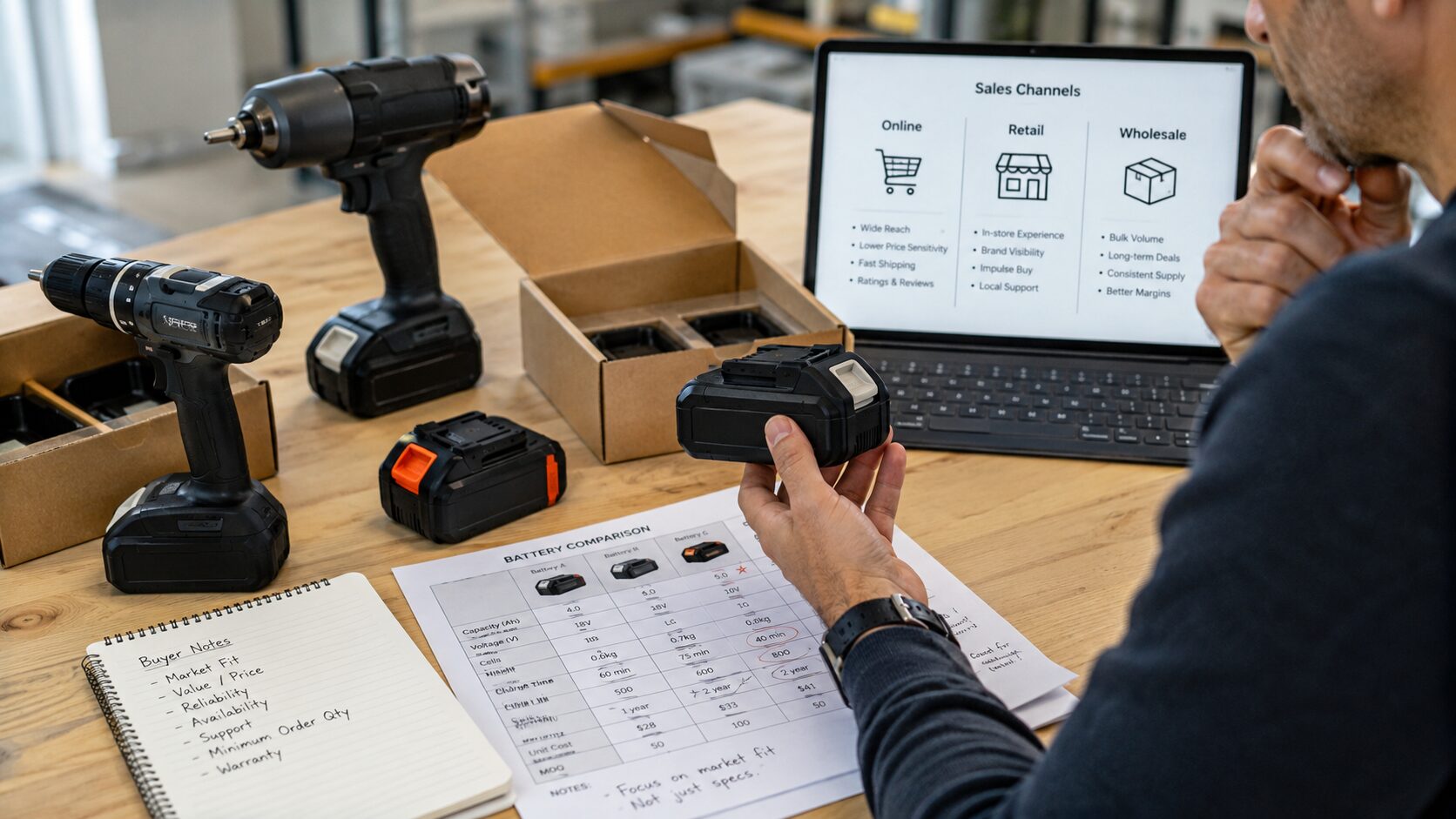
I have worked with private-label brands who wanted high-capacity batteries to position their tools as premium products. I have also worked with online sellers who needed low-cost 1-battery kits to compete on Amazon. Both buyers were right—but for completely different reasons.
Does battery capacity determine product positioning or sales channel fit?
Battery capacity affects your product positioning more than it affects runtime.[^1] A 4.0Ah battery configuration signals something different to buyers than a 2.0Ah configuration—even if the runtime difference is only 20 minutes in real-world use.
Battery capacity is not a technical choice—it is a market positioning decision. Higher capacity allows you to position your tool as a premium or professional product.[^2] Lower capacity allows you to compete on price or create entry-level product lines. The right capacity depends on what position you want to occupy in your target market.
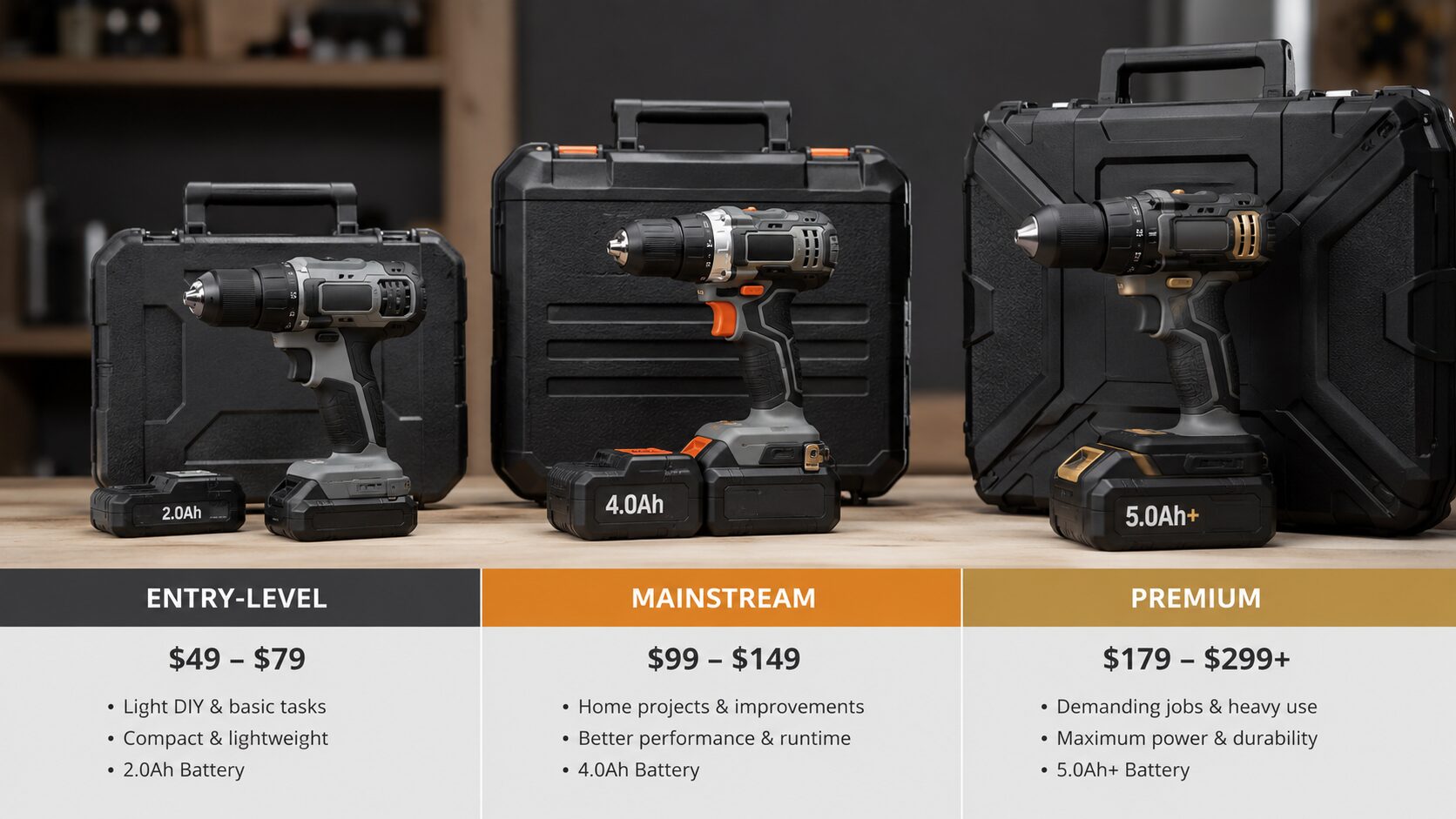
I worked with a private-label brand that wanted to launch a cordless drill line in the Australian market. They originally asked for 5.0Ah battery configurations because they wanted to position the product as professional-grade. After we discussed their target retail price and competitor positioning, we configured 4.0Ah battery kits instead. The 4.0Ah configuration allowed them to hit their target price while still maintaining a premium position above 2.0Ah entry-level competitors. The brand launched successfully and avoided the pricing pressure that a 5.0Ah configuration would have created.
Battery capacity also determines what sales channels work for your product. Online platforms reward price competitiveness—especially for new listings without review history.[^3] A 2.0Ah battery configuration allows you to list at a lower price and compete for early sales. Retail stores reward perceived value—customers compare kits side-by-side on shelves.[^4] A 4.0Ah battery configuration allows you to position your kit as a better value than competitors with smaller batteries.
The decision is not about runtime alone. It is about what configuration allows you to compete where you sell. I have seen online sellers succeed with 2.0Ah configurations on Amazon because the price was low enough to attract first-time buyers. I have also seen wholesalers struggle with 2.0Ah configurations in retail stores because customers perceived them as lower quality compared to competitors with 4.0Ah batteries on the same shelf.
| Battery Capacity | Best Channel Fit | Positioning Strategy | Typical Use Case |
|---|---|---|---|
| 2.0Ah | Online platforms, entry-level retail | Price-competitive, beginner-friendly | Launch new listings, test markets, compete on price |
| 4.0Ah | General retail, wholesale, mixed channels | Balanced value, mainstream positioning | Standard product lines, repeat orders, stable supply |
| 5.0Ah+ | Premium retail, professional channels | High-performance, professional-grade | Premium brands, niche markets, differentiation |
Battery capacity should match the price position you can defend in your sales channel. If you cannot support a premium price, a high-capacity battery will not help you—it will only increase your cost without improving your competitive position.
Should you configure 1-battery kits or 2-battery kits for your target channel?
The number of batteries in your kit changes how customers evaluate your product. A 1-battery kit is judged on price. A 2-battery kit is judged on value.[^5] The decision should be based on how your target customers make buying decisions in your specific sales channel.
1-battery kits work best when price is the primary buying factor—especially for online platforms where customers sort by lowest price first[^6]. 2-battery kits work best when perceived value matters more than upfront cost—especially in retail stores where customers compare complete kits side-by-side.
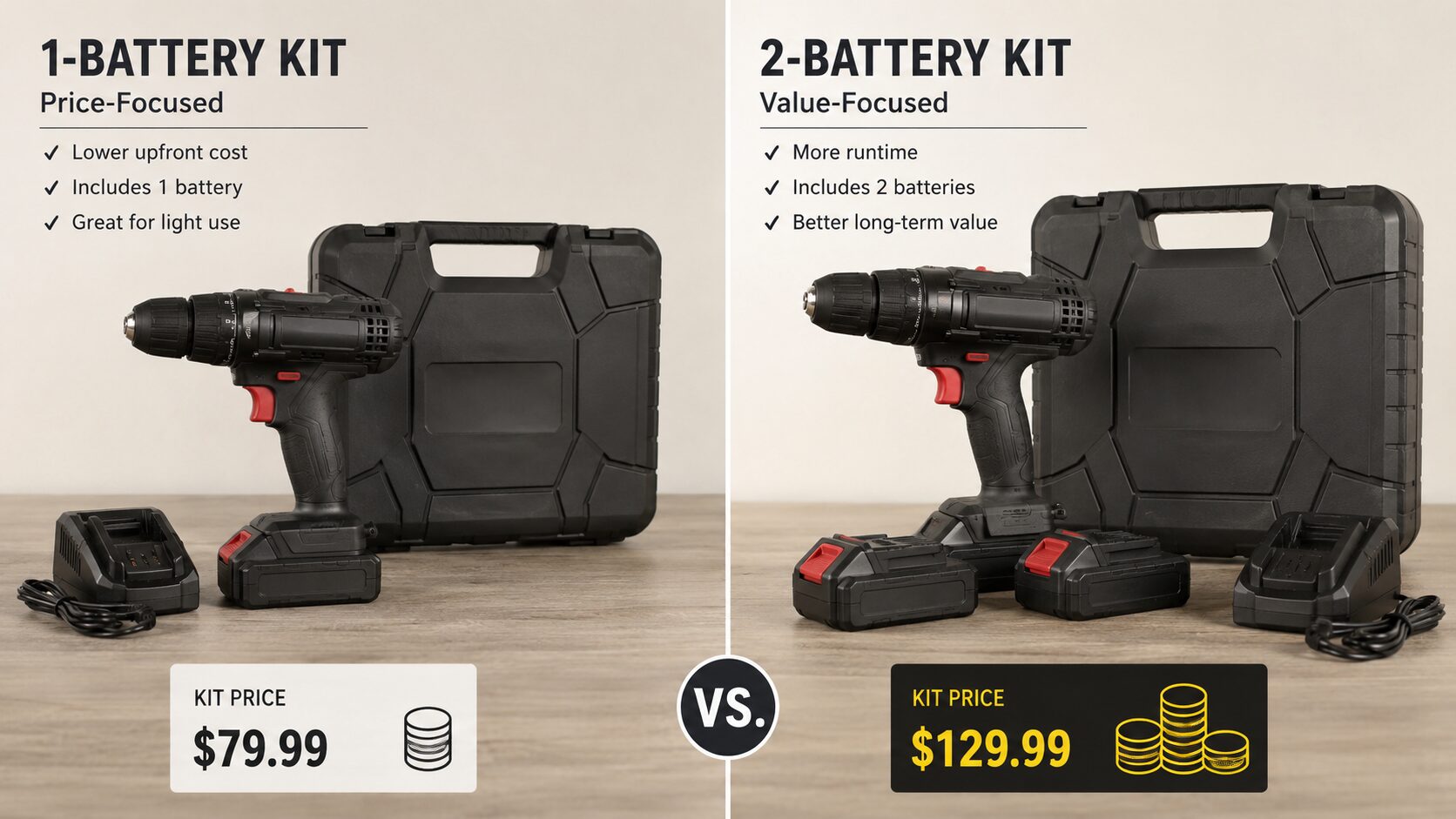
I worked with an Amazon seller who was launching a cordless angle grinder in the US market. They originally wanted to list a 2-battery kit because competitors were listing 2-battery configurations. After we analyzed their category, we found that most early sales went to listings under $80. A 2-battery kit would have positioned them above that threshold. We configured a 1-battery kit instead, priced at $69. The listing gained traction quickly because the price was low enough to attract first-time buyers who were sorting by price. Once the listing had review history, the seller introduced a 2-battery configuration as a higher-value option.
Online platforms reward price competitiveness for new listings. Customers sort by price, filter by price range, and compare prices across similar products. A 1-battery kit allows you to enter the market at a lower price point and compete for early sales. After you build review history and customer trust[^7], you can introduce 2-battery configurations for buyers who want longer runtime or better value.
Retail stores reward perceived value at the point of sale. Customers see complete kits on shelves and compare what is included in the package. A 2-battery kit signals better value because customers see two batteries, one charger, and sometimes additional accessories in one box. The upfront price is higher, but the perceived value is also higher. Retailers prefer 2-battery kits because they are easier to explain to customers and they justify higher margins.[^8]
I have also worked with wholesalers who needed to supply both configurations to different retail customers. Some retail chains wanted 1-battery kits for price-sensitive customers. Other chains wanted 2-battery kits for customers who valued complete solutions. The wholesaler ordered both configurations from us and supplied different kits to different retail partners based on their positioning strategy.
The decision is not about runtime needs alone. It is about what configuration helps you compete in your target channel. If you sell online and price matters most, start with 1-battery kits. If you sell in retail stores and value matters most, use 2-battery kits. If you supply both channels, configure both options.
Does battery platform compatibility affect your product's market fit?
Battery platform compatibility is not a technical superiority question. It is a market expectation question. Buyers in certain markets already use certain battery platforms, and they expect new tools to work with batteries they already own.[^9]
Choosing a battery platform should be based on what battery system your target customers already use or expect to see in your market—not on which platform has better technical specifications. Makita-compatible, DeWalt-compatible, Milwaukee-compatible, and Bosch-compatible platforms serve different market expectations, and the right choice depends on where you sell and who you sell to.
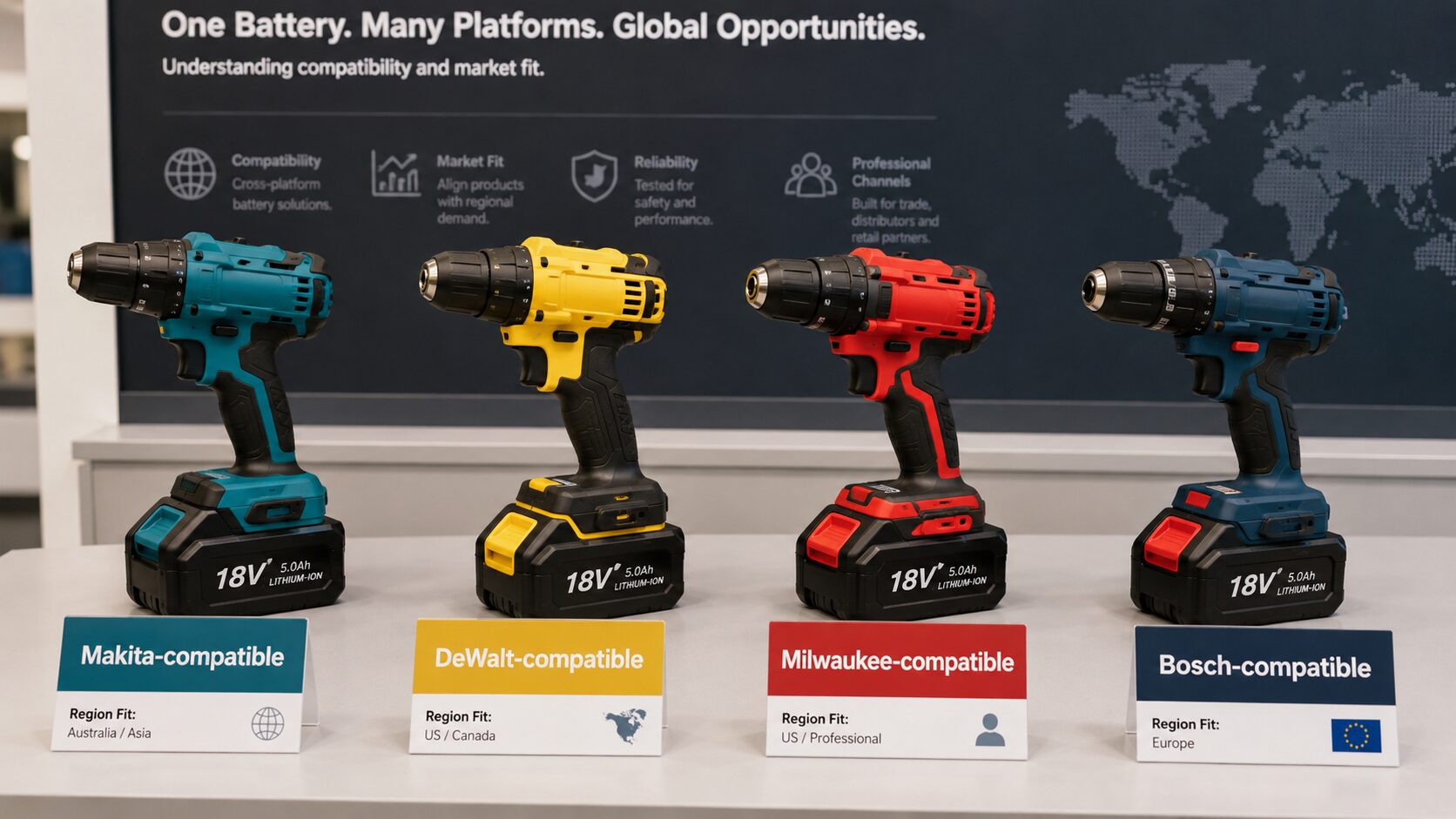
I worked with a distributor in Germany who wanted to source cordless tool kits for local hardware stores. They originally asked about DeWalt-compatible battery platforms because DeWalt is strong in the US market. After we discussed their target retail customers, we learned that Makita and Bosch battery platforms were more common in the German market. We configured Bosch-compatible battery kits instead, and the distributor successfully supplied local stores with products that matched customer expectations.
Battery platform decisions should start with market research, not technical comparisons. What battery platforms do your competitors use in your target market? What battery systems do retail customers already own? What battery interfaces do online buyers search for? The answers to these questions should guide your platform decision—not voltage ratings or cell technology.
In the US and Canadian markets, DeWalt-compatible and Milwaukee-compatible battery platforms are common because these brands have strong market presence.[^10] In European and Australian markets, Makita-compatible and Bosch-compatible platforms are more common.[^11] In emerging markets, buyers may not have strong platform preferences yet, which creates opportunities for private-label brands to introduce their own battery systems without competing against established platform expectations.
I have also worked with private-label brands who wanted to avoid direct platform compatibility and use custom battery interfaces instead. This strategy works when the brand has strong marketing resources and can educate customers about their proprietary battery system. It does not work well for new brands without marketing budgets or for online sellers who need to attract platform-comparison buyers quickly.
| Battery Platform | Strong Market Presence | Best Buyer Type | Key Consideration |
|---|---|---|---|
| Makita-compatible | Europe, Australia, Asia | Private-label brands, wholesalers, distributors | Established platform expectation in many international markets |
| DeWalt-compatible | US, Canada | Online sellers, retailers, importers | Strong brand recognition in North American DIY and professional markets |
| Milwaukee-compatible | US, professional channels | Private-label brands, specialty retailers | Associated with professional-grade positioning |
| Bosch-compatible | Europe, professional channels | Distributors, wholesalers, importers | Common in European markets with professional and DIY overlap |
| Custom platform | Emerging markets, strong brands | Private-label brands with marketing resources | Requires customer education and brand-building investment |
Battery platform compatibility should match the expectations of the customers you want to reach. If your target market already uses a certain battery system, matching that system makes your product easier to sell. If your market does not have strong platform preferences, you have more flexibility to choose based on cost, supply stability, or product line strategy.
How do you balance battery cost against perceived value in your kit configuration?
Battery cost is one of the largest cost components in a cordless tool kit.[^12] The battery you choose affects your product cost, your retail price, and your profit margin. The decision is not about choosing the cheapest battery—it is about choosing a battery that supports your pricing strategy while maintaining perceived value.
Battery cost should be balanced against perceived value at your target price point. A lower-cost battery allows you to compete on price but may reduce perceived value. A higher-cost battery increases perceived value but may push your price above competitive thresholds. The right balance depends on your positioning strategy and your target customer's price sensitivity.
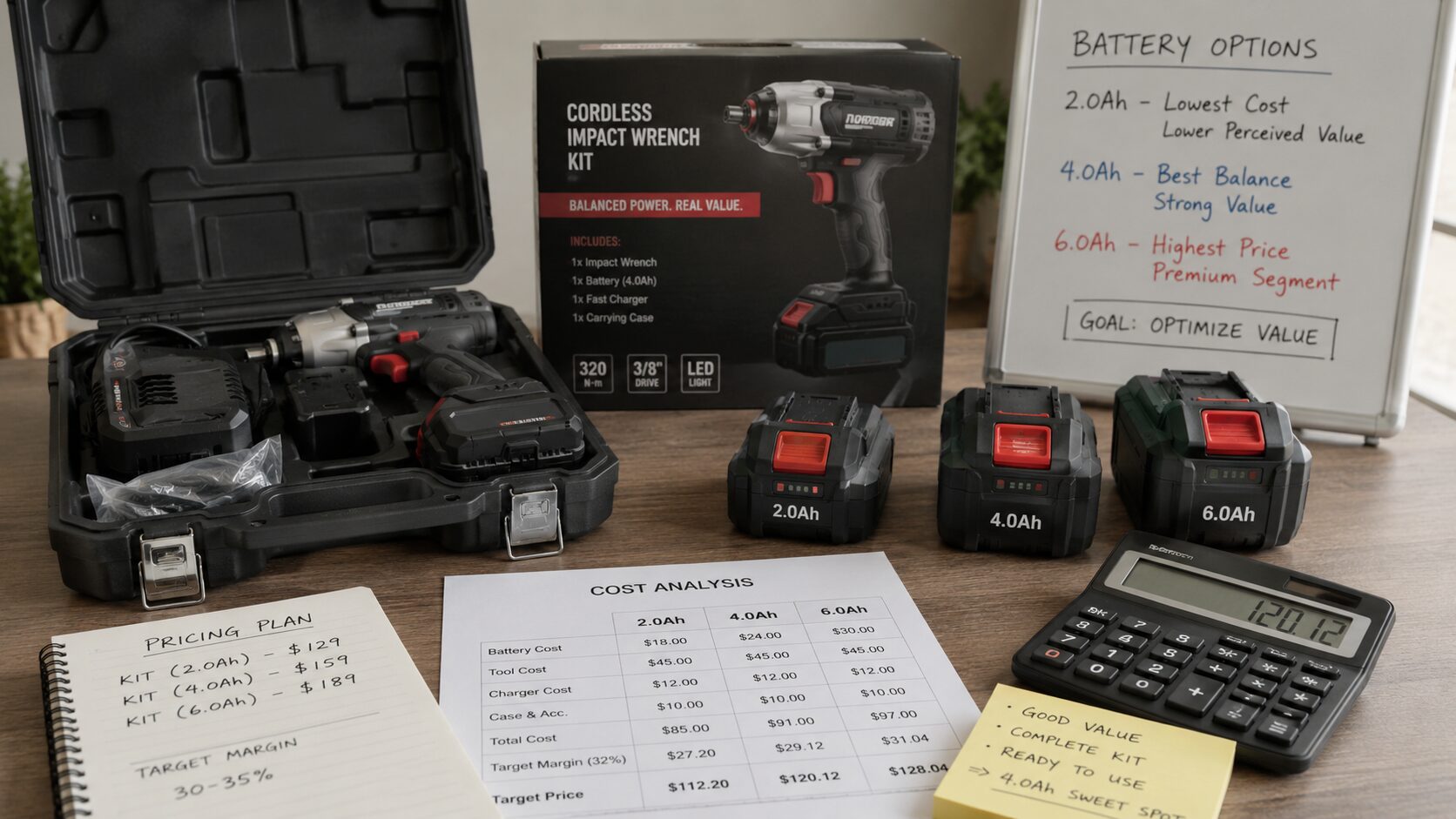
I worked with an online seller who wanted to launch a cordless impact wrench on eBay. They wanted to use 4.0Ah batteries to match competitor configurations. After we reviewed their target price and calculated their margin, we found that 4.0Ah batteries would force them to price above their competitors. We configured 3.0Ah batteries instead. The capacity was high enough to maintain perceived value, and the cost was low enough to allow competitive pricing. The seller launched successfully and gained market share because their price was slightly lower than competitors while their kit still looked complete.
Battery cost decisions should start with your target retail price, not with your desired profit margin. Calculate backward from the price customers will pay, subtract platform fees, shipping costs, and other fixed costs, and then determine how much you can allocate to the battery without losing competitiveness. If the battery cost pushes your price too high, you need to either reduce battery capacity, switch to a 1-battery configuration, or reconsider your market entry strategy.
Perceived value is not always about higher capacity. A 3.0Ah battery in a well-packaged kit with accessories may have higher perceived value than a 4.0Ah battery in a basic package. Online buyers evaluate value based on what they see in product images and descriptions. Retail buyers evaluate value based on what they see on the shelf. If your packaging, accessories, and kit presentation are strong, you can use a slightly lower-capacity battery without losing perceived value.
I have also worked with private-label brands who chose higher-cost batteries specifically to differentiate their product positioning. One brand used 5.0Ah batteries in their cordless drill line because they wanted to position the product above mainstream competitors. The higher battery cost increased their product cost by 15%, but it allowed them to justify a 25% higher retail price. The strategy worked because their target customers valued runtime and professional positioning more than price.
The decision is not about maximizing battery capacity or minimizing cost. It is about finding the configuration that supports your pricing strategy while maintaining the perceived value your target customers expect.
Conclusion
Choosing the right power tool battery is not about technical specifications—it is about configuring a battery kit that supports your sales channel, pricing strategy, and market positioning. Start with your target customer and sales channel, not with voltage and amp-hours.
[^1]: "Influence of Customer Quality Perception on the Effectiveness ... - PMC", https://pmc.ncbi.nlm.nih.gov/articles/PMC4789549/. Research on consumer inference from product attributes, together with technical explanations of amp-hour capacity, supports the distinction between battery capacity as a functional specification and as a visible signal of product tier. Evidence role: mechanism; source type: paper. Supports: A source should explain that amp-hour capacity is related to stored charge and potential runtime, while consumer research should support that visible product attributes can affect perceived quality or positioning.. Scope note: This would provide contextual support for positioning effects rather than direct proof that battery capacity is more important than runtime in every power-tool category. [^2]: "Impact of Pricing and Product Information on Consumer Buying ...", https://pmc.ncbi.nlm.nih.gov/articles/PMC8710754/. Consumer-behavior research shows that salient performance attributes can serve as quality signals and influence willingness to pay, providing contextual support for using higher battery capacity in premium positioning. Evidence role: expert_consensus; source type: paper. Supports: A source should support that higher-performing or more capable product attributes can be used as quality signals and may justify premium positioning.. Scope note: The support is general to product-attribute signaling and may not directly measure cordless power-tool battery capacity. [^3]: "Competitive pricing on online markets: a literature review - PMC", https://pmc.ncbi.nlm.nih.gov/articles/PMC9194889/. Empirical studies of e-commerce markets find that price and reputation signals such as review volume influence consumer choice, supporting the claim that new listings without reviews face stronger pressure to compete on price. Evidence role: general_support; source type: paper. Supports: A source should show that online buyers are sensitive to price and that review volume or seller reputation affects purchase likelihood in marketplaces.. Scope note: The evidence would support the mechanism generally across e-commerce, not necessarily every power-tool marketplace listing. [^4]: "The Impact of Visual Elements of Packaging Design on Purchase ...", https://pmc.ncbi.nlm.nih.gov/articles/PMC11851823/. Retail-consumer research indicates that shelf presentation and point-of-purchase comparisons shape perceived value and choice, supporting the article’s statement about side-by-side kit evaluation in stores. Evidence role: mechanism; source type: paper. Supports: A source should support that in-store shoppers use shelf presentation, packaging, and side-by-side comparisons to evaluate value.. Scope note: The evidence is likely contextual and may not specifically study cordless power-tool kits. [^5]: "Buyer and seller beware: Bundling affects how consumer products ...", https://www.chicagobooth.edu/media-relations-and-communications/press-releases/buyer-and-seller-beware-bundling-affects-how-consumer-products-are-valued. Research on product bundling shows that adding complementary components can alter perceived value and price evaluation, providing contextual support for distinguishing one-battery and two-battery kit perceptions. Evidence role: mechanism; source type: paper. Supports: A source should support that bundling additional components can shift consumer evaluation from unit price toward perceived total value.. Scope note: The source would support bundling effects generally, not prove that all customers judge one-battery kits only on price. [^6]: "The Influence of Price on Purchase Intentions - PMC", https://pmc.ncbi.nlm.nih.gov/articles/PMC7911682/. Studies of online shopping behavior show that digital marketplaces facilitate price comparison and sorting, supporting the article’s claim that lowest-price-first behavior can affect online product evaluation. Evidence role: general_support; source type: paper. Supports: A source should support that online shopping environments reduce price-search costs and make price sorting or price comparison salient to customers.. Scope note: This supports the general behavior; actual sorting frequency may vary by platform, category, and buyer intent. [^7]: "Purchasing in the digital age: A meta-analytical perspective on trust ...", https://pmc.ncbi.nlm.nih.gov/articles/PMC11044045/. E-commerce research finds that customer reviews and review volume affect trust and purchase intention, supporting the claim that review history can improve buyer confidence in a listing. Evidence role: expert_consensus; source type: paper. Supports: A source should show that online reviews and review volume are associated with consumer trust, perceived risk reduction, and purchase intention.. Scope note: The evidence supports trust formation generally and does not determine the exact point at which a seller should add a second kit configuration. [^8]: "[PDF] strategic use of bundling for - reducing consumers' perceived risk", https://experts.boisestate.edu/files/735561/fulltext.pdf. Retailing and product-bundling literature indicates that bundled offerings can raise perceived value and create opportunities for margin management, providing contextual support for retailer interest in two-battery kits. Evidence role: general_support; source type: paper. Supports: A source should support that bundles can increase perceived value, simplify comparison, and create margin opportunities for retailers.. Scope note: This does not directly verify that retailers in the power-tool category prefer two-battery kits in all markets. [^9]: "Exploring the Role of Installed Base, Platform Quality and ...", https://www.hbs.edu/ris/download.aspx?name=08-031.pdf. Platform-economics research shows that installed bases and compatibility reduce switching costs and influence product choice, supporting the claim that existing battery ownership can shape expectations for new cordless tools. Evidence role: mechanism; source type: paper. Supports: A source should support that installed bases, compatibility, and switching costs influence consumer adoption of platform-dependent products.. Scope note: The evidence supports the platform mechanism generally and may not quantify battery-platform preferences in a specific country. [^10]: "The Power Tools Market is Changing: Here's How - OpenBrand", https://openbrand.com/newsroom/blog/power-tools-market-trends-infographic. Independent market research on North American power-tool brands would support the statement that DeWalt and Milwaukee have substantial regional market presence, making compatibility with their battery platforms commercially relevant. Evidence role: statistic; source type: research. Supports: A source should provide independent evidence of DeWalt and Milwaukee market presence, share, distribution, or brand penetration in North American power-tool markets.. [^11]: "Power Tools Market Global Industry Analysis and Forecast (2026", https://www.stellarmr.com/report/power-tools-market/2591. Independent market or industry data on European and Australian power-tool brand presence would support the claim that Makita and Bosch platforms are comparatively common in those regions. Evidence role: statistic; source type: research. Supports: A source should document Makita and Bosch brand presence, market share, or distribution strength in European and Australian power-tool markets.. Scope note: The claim may vary by country, retailer segment, and professional versus DIY channel. [^12]: "Lithium-Ion Battery - Clean Energy Institute - University of Washington", https://www.cei.washington.edu/research/energy-storage/lithium-ion-battery/. Industry or engineering cost analyses of cordless products and lithium-ion battery packs would support the statement that the battery is a major component of total kit cost. Evidence role: statistic; source type: research. Supports: A source should provide cost breakdowns or industry analysis showing that lithium-ion battery packs are a significant portion of cordless-tool kit cost.. Scope note: Battery cost share depends on cell chemistry, pack capacity, supplier pricing, charger inclusion, and tool category.